
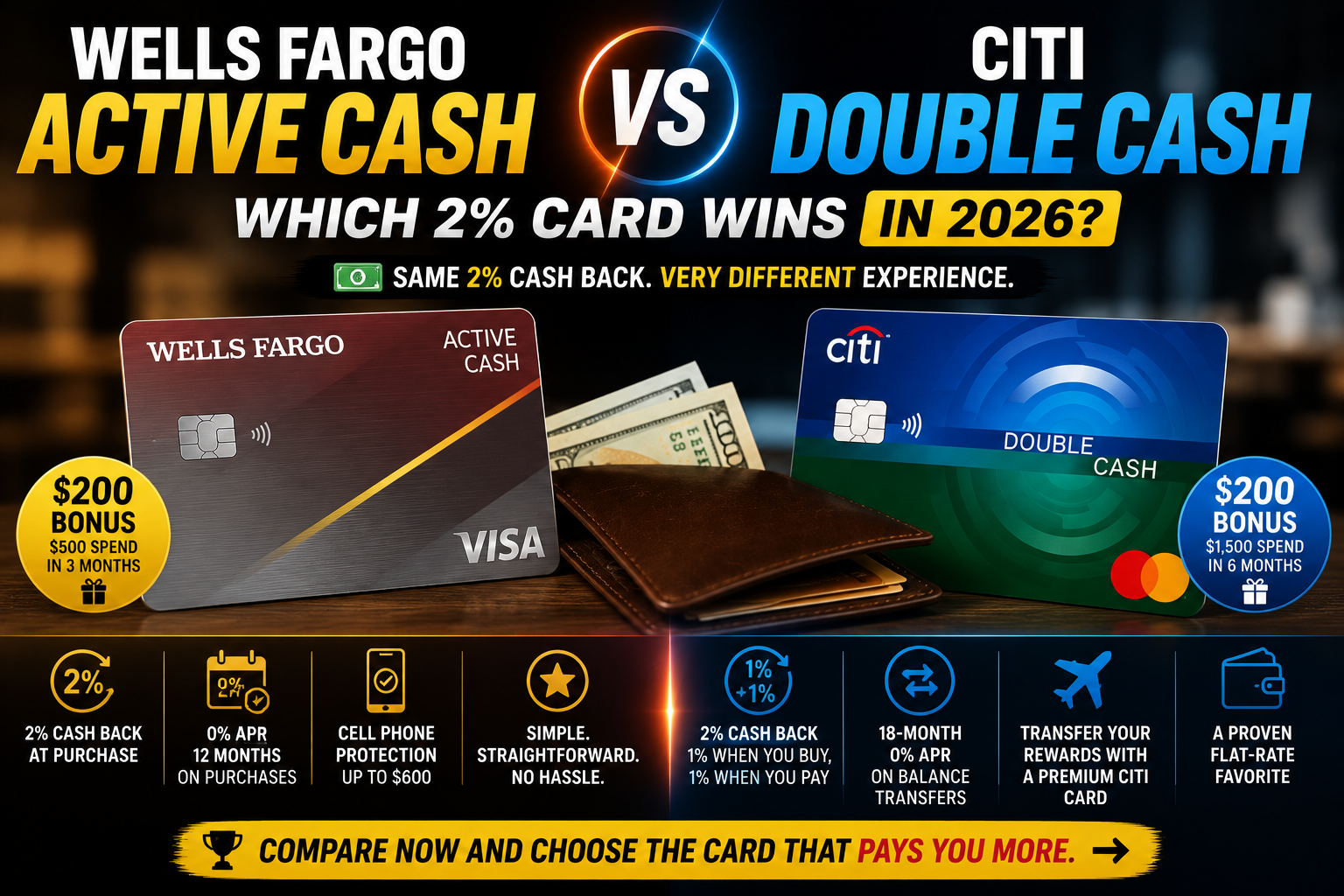

Wells Fargo Active Cash vs Citi Double Cash 2026: Which 2% Card Wins?
Both of these cards promise the same headline number: 2% cash back with no annual fee. This Wells Fargo Active Cash vs Citi Double Cash comparison digs into how each card actually delivers that 2%, plus the welcome bonus, APR, and perks that separate them.
Wells Fargo Active Cash vs Citi Double Cash: Quick Comparison
| Feature | Wells Fargo Active Cash | Citi Double Cash |
|---|---|---|
| Annual Fee | $0 | $0 |
| Earning Rate | Flat 2% at time of purchase | 2% split: 1% on purchase + 1% on payment |
| Welcome Bonus | $200 after $500 spend in 3 months | $200 after $1,500 spend in 6 months |
| Intro APR on Purchases | 0% for 12 months | None |
| Intro APR on Balance Transfers | 0% for 12 months | 0% for 18 months |
| Cell Phone Protection | Yes, up to $600 ($25 deductible) | No |
| Travel Transfer Partners | None | Yes, when paired with a premium Citi card |
| Foreign Transaction Fee | 3% | 3% |
In this Wells Fargo Active Cash vs Citi Double Cash matchup, the real difference isn’t the rewards rate — it’s how each card gets you there and what surrounds it. For official terms, see Wells Fargo’s official Active Cash page.

The 2% Delivery Difference
Wells Fargo Active Cash pays a straight 2% the moment you make a purchase, no strings attached. Citi Double Cash splits the same 2% into two halves — 1% on purchase, 1% when you pay it off — which means you only capture the full rate if you actually pay your bill. In practice, most cardholders who pay in full see identical results, but Active Cash is simpler to track.
Where Wells Fargo Active Cash pulls further ahead is the welcome bonus and intro APR: a $500 spend threshold in 3 months versus Citi’s $1,500 in 6 months, plus a 0% intro APR that applies to new purchases (not just balance transfers). Active Cash also throws in cell phone protection up to $600 per claim.
Citi Double Cash’s advantage shows up for people who want travel flexibility — if you already hold a premium Citi ThankYou card like the Citi Strata Premier, Double Cash rewards can transfer to airline and hotel partners, something Active Cash’s straight cash rewards can’t do.
Pros and Cons
Wells Fargo Active Cash Pros
- Easier welcome bonus to reach ($500 vs $1,500 spend)
- 0% intro APR on both purchases and balance transfers
- Cell phone protection included
- Simpler, single-step earning structure
Citi Double Cash Pros
- Longer 18-month intro APR on balance transfers
- Can unlock airline and hotel transfer partners with a premium Citi card
- Well-established, long-running flat-rate option
Who Should Get Each Card
| Your Situation | Best Card |
|---|---|
| You want the easiest welcome bonus to unlock | ✅ Wells Fargo Active Cash |
| You have a large purchase to finance interest-free | ✅ Wells Fargo Active Cash |
| You already hold a premium Citi travel card | ✅ Citi Double Cash |
| You need a long balance transfer window | ✅ Citi Double Cash |
| You want cell phone protection built in | ✅ Wells Fargo Active Cash |
Curious how either of these stacks up against a third option? See our Citi Double Cash vs Chase Freedom Unlimited comparison, or check our Best Credit Card for Groceries guide for category-specific alternatives.
Frequently Asked Questions
Which card is easier to earn the welcome bonus on?
Wells Fargo Active Cash, which requires just $500 in spending within 3 months, compared to Citi Double Cash’s $1,500 within 6 months for the same $200 bonus.
Do I need to pay my balance in full to get 2% with Citi Double Cash?
Yes — you earn 1% when you make a purchase and the second 1% only when you pay it off, so carrying a balance without paying means you miss half the reward.
Does Wells Fargo Active Cash offer cell phone protection?
Yes, up to $600 per claim with a $25 deductible when you pay your monthly cell phone bill with the card — a benefit Citi Double Cash doesn’t offer.
Can Citi Double Cash rewards transfer to airline miles?
Only if you also hold a premium Citi ThankYou card, such as the Citi Strata Premier; held on its own, Double Cash behaves like a straight cash-back card.
Do both cards charge foreign transaction fees?
Yes, both charge a 3% foreign transaction fee, so neither is ideal as a primary card for international travel.
Disclaimer: This article is for informational purposes only and does not constitute financial advice. Card terms, fees, and rewards are subject to change by the issuer; always verify current rates and fees directly with Wells Fargo or Citi before applying. We may earn a commission from partner links, which does not affect the objectivity of our reviews.