
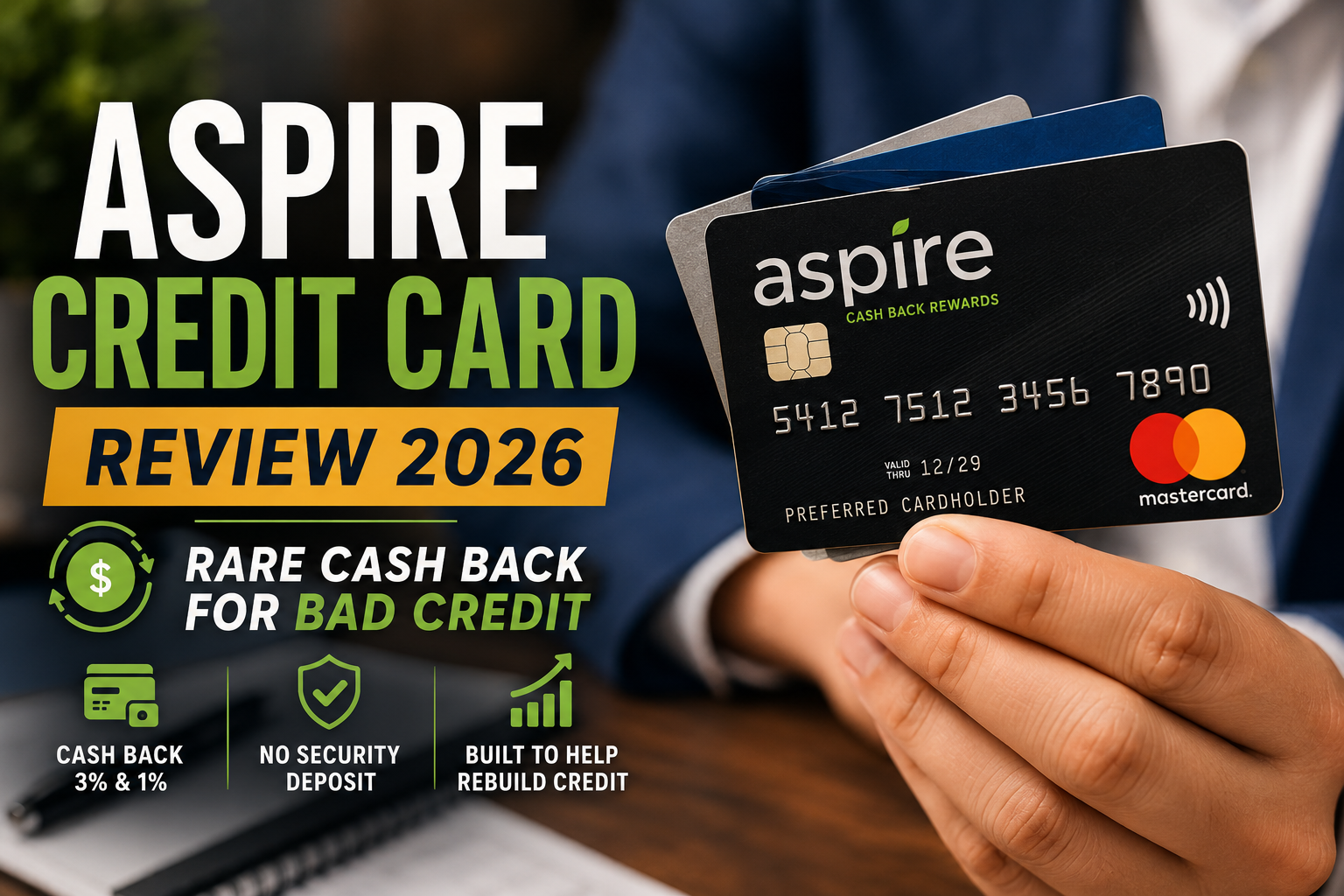

Aspire Credit Card Review 2026: Rare Cash Back for Bad Credit, at a Price
Most unsecured cards built for bad credit skip rewards entirely — you pay high fees and get nothing back. The Aspire Credit Card is one of the few exceptions in this space, offering real cash back on everyday spending. That’s a genuine point of difference, but it doesn’t erase the cost structure that comes with almost every subprime card on the market. Here’s what the numbers actually look like before you apply.
Aspire Credit Card: Key Details at a Glance
| Feature | Details |
|---|---|
| Issuer | Atlanticus (NASDAQ: ATLC) |
| Annual Fee | $49-$175 the first year (based on creditworthiness); $0-$49 after that |
| Monthly Fee | $5-$15/month starting year two (up to $180/year) |
| Regular APR | 29.99%-36.00% (fixed, varies by creditworthiness) |
| Credit Limit | Up to $1,000 (no security deposit required) |
| Rewards | 3% cash back on gas, groceries, and utilities; 1% on other purchases |
| Credit Bureaus Reported To | Experian, Equifax, TransUnion |
You can check current pre-qualification terms directly on the issuer’s site: Aspire Cash Back Rewards Mastercard official website.

How the Aspire Credit Card Actually Works
The Aspire Cash Back Rewards Mastercard is issued by Atlanticus, a publicly traded financial technology company that operates several subprime credit card brands. Like Indigo and Milestone, it’s an unsecured card built for people with bad or limited credit — no deposit required, with pre-qualification available through a soft credit check that won’t ding your score before you apply.
What sets Aspire apart is the rewards structure: 3% cash back on gas, groceries, and utility payments, plus 1% on everything else. That’s genuinely rare in this card category — most competitors, including Indigo and Milestone, offer zero rewards. The trade-off is that fees here vary by creditworthiness, and the range is wide. On the low end, you might pay $49 in year one; on the high end, $175. From year two, that annual fee drops but a monthly maintenance fee of $5 to $15 kicks in, meaning your true cost in year two and beyond could run as low as $60 a year or as high as $229.
Cash back is paid out once a year as a statement credit on your account anniversary, and it can be forfeited if your account isn’t in good standing at that point — so this only pays off if you keep the account current. There’s also no credit limit increase program, meaning your starting limit is the limit you’ll have for the life of the account unless you’re approved for a different product.
Pros and Cons
Pros
- Rare cash back rewards for a bad-credit card (3% and 1%)
- No security deposit required
- Soft-pull pre-qualification available
- Reports to all three major credit bureaus
- Credit limit up to $1,000
Cons
- Fee range is wide and depends on your credit profile
- Very high APR (29.99%-36%)
- Monthly maintenance fee added starting year two
- No automatic credit limit increase program
- Cash back can be forfeited if account isn’t in good standing
Who Should Get This Card
| Good Fit If You… | Not a Good Fit If You… |
|---|---|
| Want cash back while rebuilding credit, not just a bare-bones card | Tend to carry a balance month to month |
| Spend regularly on gas, groceries, or utilities | Need a guaranteed low fee regardless of credit profile |
| Can pay your balance in full every month | Want automatic credit line increases over time |
| Don’t have funds available for a security deposit | Can qualify for a lower-fee secured card instead |
If the fee range here feels uncertain, it’s worth comparing this card side by side with our Milestone Credit Card Review, which has a fixed (rather than variable) fee structure. And if rewards matter to you but you’d rather avoid the subprime card category altogether, our Verve Credit Card Review covers another unsecured option worth comparing.
Frequently Asked Questions
Does the Aspire Credit Card require a security deposit?
No. It’s an unsecured card, so you get a credit limit of up to $1,000 without putting down a deposit.
How does the cash back program work on this card?
You earn 3% cash back on gas, groceries, and utility purchases, and 1% on everything else. The cash back is paid annually as a statement credit and can be forfeited if your account isn’t in good standing.
Why does the annual fee vary so much?
The fee (and APR) depends on your individual credit profile at the time of application. Applicants with credit closer to the “fair” range typically get offers at the lower end of the $49-$175 range.
Can this card increase my credit limit over time?
No. Unlike some competitors, Aspire does not offer an automatic credit limit increase program, so your starting limit will likely stay fixed.
Is the Aspire Credit Card better than Indigo or Milestone?
It depends on your priorities. This one is the only card of the three with a rewards program, but Indigo and Milestone have simpler, fixed fee structures that are easier to predict. Compare all three before applying.
Disclaimer: This review is for informational purposes only and does not constitute financial advice. Card terms, fees, and APRs vary by applicant and are subject to change by the issuer; always confirm current details directly with Atlanticus or the Aspire card website before applying. Best Card Guide may earn a commission from some of the links on this page.