
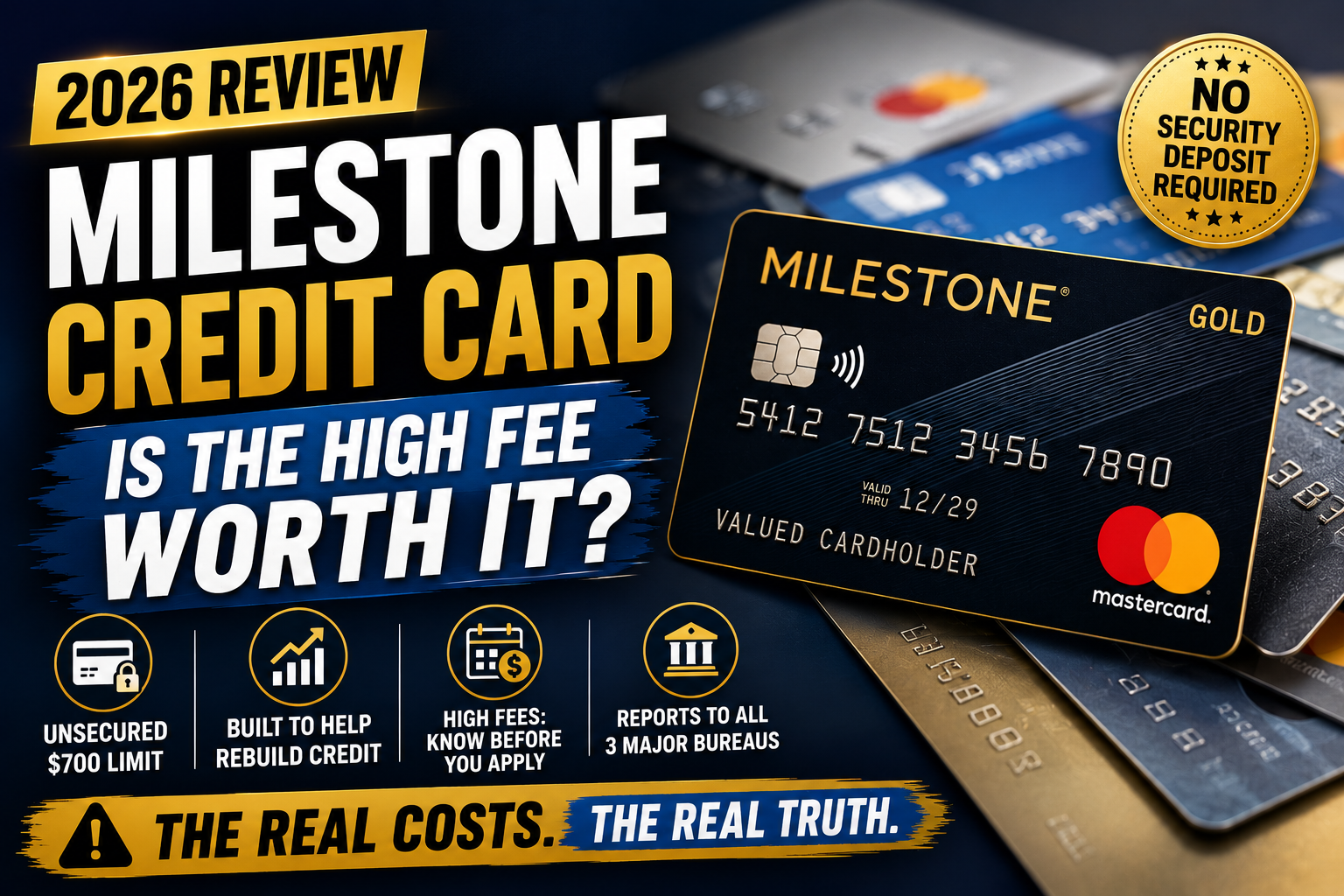

Milestone Credit Card Review 2026: Is the High Fee Worth It?
If you’re rebuilding credit and keep running into the same wall — approved, but only for cards that demand a security deposit you don’t have — the Milestone Credit Card shows up in almost every search. It’s an unsecured Mastercard aimed squarely at people with bad or limited credit, and it doesn’t ask for a deposit to open the account. That accessibility comes at a real cost, though, and this review breaks down exactly what you’d be paying for before you apply.
Milestone Credit Card: Key Details at a Glance
| Feature | Details |
|---|---|
| Issuer | The Bank of Missouri, serviced by Concora Credit |
| Annual Fee | $175 the first year; $49 thereafter |
| Monthly Fee | $0 the first year; $12.50/month starting year two (~$150/year) |
| Regular APR | 35.9% (fixed) |
| Credit Limit | $700 initial limit (no security deposit required) |
| Foreign Transaction Fee | 1% |
| Rewards | None |
| Credit Bureaus Reported To | Experian, Equifax, TransUnion |
You can review the current offer terms directly on the issuer’s site: Milestone Gold Card official website.

How the Milestone Credit Card Actually Works
The Milestone Credit Card is issued by The Bank of Missouri and serviced by Concora Credit — the same company behind the Indigo Mastercard, so you’ll notice the two cards share a nearly identical fee structure and a matching 35.9% fixed APR. The pitch is simple: no security deposit, an unsecured $700 credit line, and monthly reporting to all three major credit bureaus so responsible use can help rebuild your score over time.
The catch is the price of that access. The $175 first-year annual fee is deducted from your credit line the moment your account opens, which means your real starting purchasing power is closer to $525, not $700. From year two onward, the annual fee drops to $49, but a new $12.50 monthly fee kicks in — adding roughly $150 a year in fees you won’t see reflected in the advertised numbers. Combined, that’s close to $200 a year just to keep the account open, on top of a 35.9% APR that makes carrying any balance extremely expensive.
There’s no rewards program of any kind, which is standard for this card category but worth noting if you’re comparing it against similar cards that do offer cash back. The one genuine strength here is accessibility: approval odds are meaningfully higher than for most mainstream cards, and there’s no deposit to save up for first.
Pros and Cons
Pros
- No security deposit required
- Reports to all three major credit bureaus
- Higher approval odds for bad or limited credit
- $700 credit limit without a deposit requirement
- Includes Mastercard Zero Liability and ID theft protection
Cons
- High first-year annual fee ($175) reduces available credit immediately
- Ongoing monthly fee starting in year two (~$150/year)
- Very high 35.9% fixed APR
- No rewards or cash back of any kind
- 1% foreign transaction fee on top of everything else
Who Should Get This Card
| Good Fit If You… | Not a Good Fit If You… |
|---|---|
| Don’t have money for a security deposit right now | Can qualify for a secured card with lower fees instead |
| Can commit to paying the balance in full every month | Tend to carry a balance month to month |
| Need triple-bureau reporting to rebuild credit fast | Want a card with rewards or cash back |
| Plan to use it short-term (6-18 months) before upgrading | Are looking for a long-term, low-fee credit card |
If the fees on this card give you pause, it’s worth comparing it against other bad-credit options we’ve reviewed, including our Verve Credit Card Review, which carries a different fee structure worth weighing side by side. And if you’re specifically trying to avoid deferred-interest traps in credit-building products, our CareCredit Card Review covers a different type of card where the fine print matters just as much.
Frequently Asked Questions
Does the Milestone Credit Card require a security deposit?
No. This card is unsecured, meaning you get a $700 credit line without putting down a deposit — unlike most secured cards for bad credit.
What credit score do I need to qualify?
It’s designed for people with bad, limited, or no credit history, generally below 640. Approval isn’t guaranteed and depends on your full credit profile.
How much does it really cost per year?
In year one, you’ll pay a $175 annual fee. From year two on, it’s a $49 annual fee plus a $12.50 monthly fee, which adds up to roughly $199 a year in total fees.
Can this card help rebuild my credit?
Yes, if used responsibly. It reports to Experian, Equifax, and TransUnion every month, so on-time payments and low utilization can help improve your score over time.
Is there a better alternative?
It depends on your situation. If you can afford a security deposit, secured cards often carry lower fees. If you specifically need an unsecured option, it’s worth comparing this offer against similar cards like Indigo before applying, since fees and limits vary.
Disclaimer: This review is for informational purposes only and does not constitute financial advice. Card terms, fees, and APRs are subject to change by the issuer; always confirm current details directly with The Bank of Missouri or Concora Credit before applying. Best Card Guide may earn a commission from some of the links on this page.