
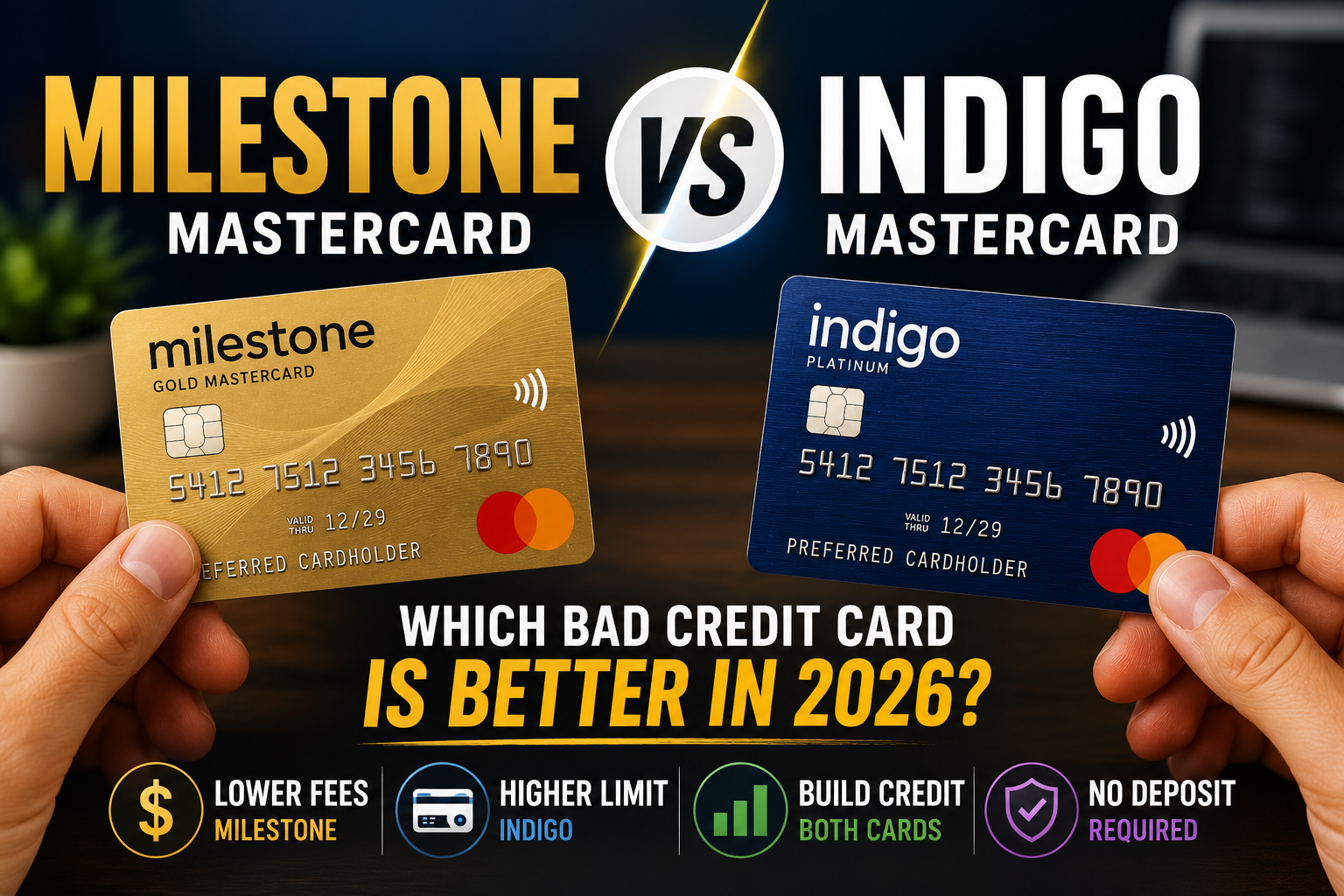

Milestone vs Indigo Mastercard comes down to one tradeoff: Milestone charges lower fees on a smaller $700 credit limit, while Indigo charges more but starts you off with a $1,000 limit — and both are serviced by the same company, Concora Credit.
Both cards target consumers with poor or limited credit who can’t qualify for mainstream unsecured cards. Neither requires a security deposit, and both report monthly to Experian, TransUnion, and Equifax. The real decision comes down to how much credit room you need versus how much you’re willing to pay for it.
Milestone vs Indigo Mastercard: Key Details at a Glance
| Feature | Milestone | Indigo |
|---|---|---|
| Issuer | The Bank of Missouri | Celtic Bank |
| Annual Fee | $175 year 1, $49 after | $250 year 1, $99 after |
| Monthly Fee (Year 2+) | $12.50/month ($150/year) | $19.25/month (~$231/year) |
| Starting Credit Limit | $700 | $1,000 |
| APR | 35.9% fixed | 35.9% fixed |
| Security Deposit | None | None |
| Servicer | Concora Credit | Concora Credit |
Both cards’ fees and limits can vary by individual creditworthiness — check your personalized offer through the official Milestone prequalification page before applying.

Milestone vs Indigo: Which One Costs Less Over Two Years?
Run the math and Milestone comes out cheaper in nearly every scenario. In year one, Milestone’s $175 fee versus Indigo’s $250 fee is a $75 difference before you’ve made a single purchase. In year two, Milestone’s combined annual and monthly fees total around $199, while Indigo’s total closer to $330 once the $19.25 monthly fee is added to the $99 annual fee. Over two years, Milestone typically costs $374 versus roughly $580 for Indigo.
The tradeoff is credit room. Indigo’s $1,000 starting limit gives you more available credit even after fees are deducted, while Milestone’s $700 limit shrinks further once its first-year fee hits. If keeping utilization low matters more to you than minimizing total fees, Indigo’s higher limit can offset its higher cost.
Who Should Pick Each Card
| Profile | Better Fit |
|---|---|
| Wants the lowest total fees | Milestone — roughly $200 cheaper over two years |
| Needs more available credit | Indigo — $1,000 limit vs. $700 |
| Wants cash back while rebuilding | Neither — consider the Aspire Mastercard instead |
| Prefers a simpler, lower-fee alternative | Consider the Destiny Mastercard, another Concora Credit card |
Neither Milestone nor Indigo offers rewards, and both share the same 35.9% APR, so the decision mostly comes down to fee tolerance versus credit limit. For a full breakdown of each card individually, see our Milestone Credit Card review and our Indigo Mastercard review.
Frequently Asked Questions
Milestone vs Indigo: which is better for bad credit?
Milestone is cheaper overall, while Indigo offers a higher starting credit limit. Both report to all three credit bureaus and can help rebuild credit with responsible use, regardless of which one you choose.
Are Milestone and Indigo the same company?
No, but they’re closely related. Milestone is issued by The Bank of Missouri and Indigo is issued by Celtic Bank, though both are serviced by Concora Credit, which handles billing, customer service, and account management for both cards.
Which card has a lower annual fee, Milestone or Indigo?
Milestone has the lower annual fee, at $175 in year one compared to Indigo’s $250. Milestone’s fees stay lower in every subsequent year as well.
Do Milestone and Indigo require a security deposit?
No. Both are unsecured credit cards, meaning approved applicants don’t need to put down any deposit to open the account.
Can I get approved for both cards?
Both cards use a soft-pull prequalification process that doesn’t affect your credit score, so checking your odds for each doesn’t hurt you. However, applying for multiple cards in a short period can affect your credit through hard inquiries once you formally apply.
Disclaimer: We are not financial advisors. This review is for informational purposes only and reflects publicly available terms as of 2026. Card terms, fees, and APRs can change — always confirm current details directly with the issuer before applying.