
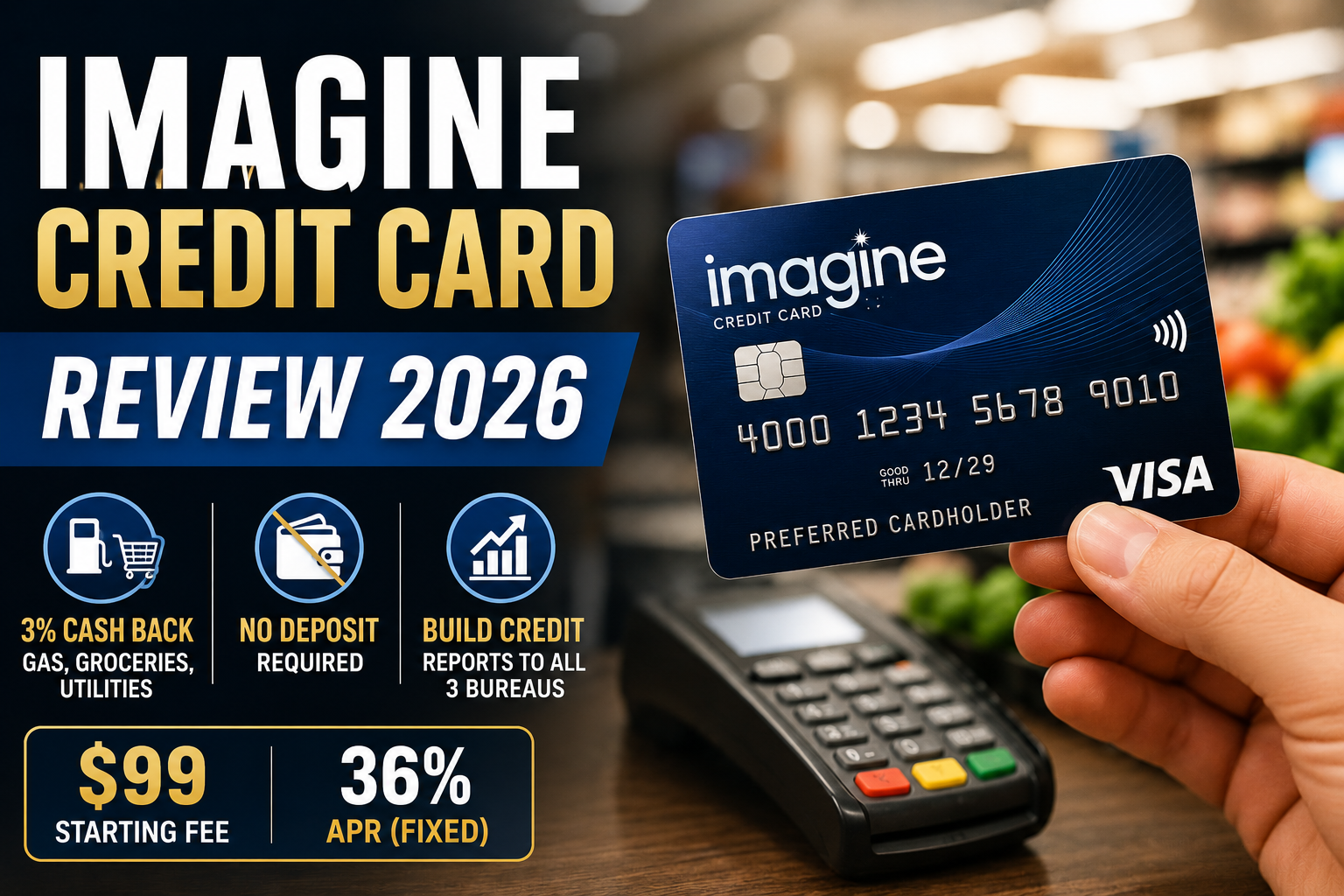

The Imagine Credit Card is an unsecured Visa for bad and fair credit that stands out from similar cards by paying real cash back — 3% on gas, groceries, and utilities — despite an annual fee starting at $99 and a 36% fixed APR, according to NerdWallet and the card’s official terms.
Issued by WebBank and serviced by Atlanticus, Imagine targets consumers with limited or damaged credit who want to avoid a security deposit. Approved cardholders typically get a starting credit limit between $350 and $700, up to a maximum of $1,000, and the account reports monthly to Experian, TransUnion, and Equifax.
Key Details at a Glance
| Feature | Details |
|---|---|
| Issuer | WebBank, serviced by Atlanticus |
| Network | Visa |
| Annual Fee | As low as $99 (range $85–$175 year 1); $39–$59 renewal |
| Maintenance Fee | $180/year ($15/month) starting year two, most common offer |
| APR | 36% fixed (most applicants) |
| Rewards | 3% cash back on gas, groceries, utilities; 1% on other purchases |
| Credit Limit | $350–$700 typical, up to $1,000 |
| Foreign Transaction Fee | 3% of each transaction |
Applicants can check their approval odds through the official Imagine prequalification page, which uses a soft credit pull that doesn’t affect your credit score.

Why the Cash Back Actually Matters Here
Most cards in this category — Milestone, Reflex, Destiny — offer zero rewards. Imagine is the exception, and according to Firstcard’s breakdown, that difference is real, not marketing: 3% back on gas, groceries, and utilities can meaningfully offset the fees for someone who already spends in those categories every month.
The math still favors caution, though. NerdWallet’s analysis notes that between the annual fee and the $180 yearly maintenance fee starting in year two, total costs can exceed $300 in year two alone — a number that easily wipes out any cash back earned on a modest credit limit. The rewards make Imagine more competitive than its no-rewards peers, but they don’t make the card cheap.
Pros and Cons
Pros
|
Cons
|
Who Should Get This Card
The Imagine Credit Card fits some financial situations better than others.
| Profile | Fit |
|---|---|
| Spends heavily on gas and groceries monthly | Good fit — 3% cash back offsets some of the fee cost |
| Wants a card on the Visa network specifically | Good fit — one of the few subprime options on Visa |
| Can afford a refundable security deposit | Poor fit — a secured card will almost always cost less |
| Wants the simplest, lowest-fee option | Consider the Destiny Mastercard instead |
If you’re comparing rewards against fees, our Aspire Credit Card review covers another rare rewards option in this category, and our Milestone vs Indigo comparison breaks down two no-rewards alternatives with lower starting fees.
Frequently Asked Questions
Is the Imagine Credit Card a legitimate credit card?
Yes. Imagine is issued by WebBank, an FDIC-insured Utah industrial bank, and serviced by Atlanticus Holdings, a publicly traded company (NASDAQ: ATLC). It reports account activity to Experian, TransUnion, and Equifax every month.
Does the Imagine Credit Card require a security deposit?
No. Imagine is an unsecured credit card, meaning approved applicants don’t need to put down any cash deposit to open the account.
Does the Imagine Credit Card really offer cash back?
Yes. Cardholders earn 3% cash back on gas, groceries, and utilities, and 1% on all other purchases — a real rewards program, unlike most competing cards in this credit tier.
How much does the Imagine Credit Card cost per year?
Fees start as low as $99 in year one, with $39 to $59 in renewal years, plus a maintenance fee of up to $180 per year starting in year two. The exact terms depend on the offer presented at prequalification.
Can I check if I qualify without hurting my credit score?
Yes. Imagine’s prequalification process uses a soft credit pull, which doesn’t affect your credit score. A hard inquiry only occurs if you proceed with the full application.
Disclaimer: We are not financial advisors. This review is for informational purposes only and reflects publicly available terms as of 2026. Card terms, fees, and APRs can change — always confirm current details directly with the issuer before applying.