
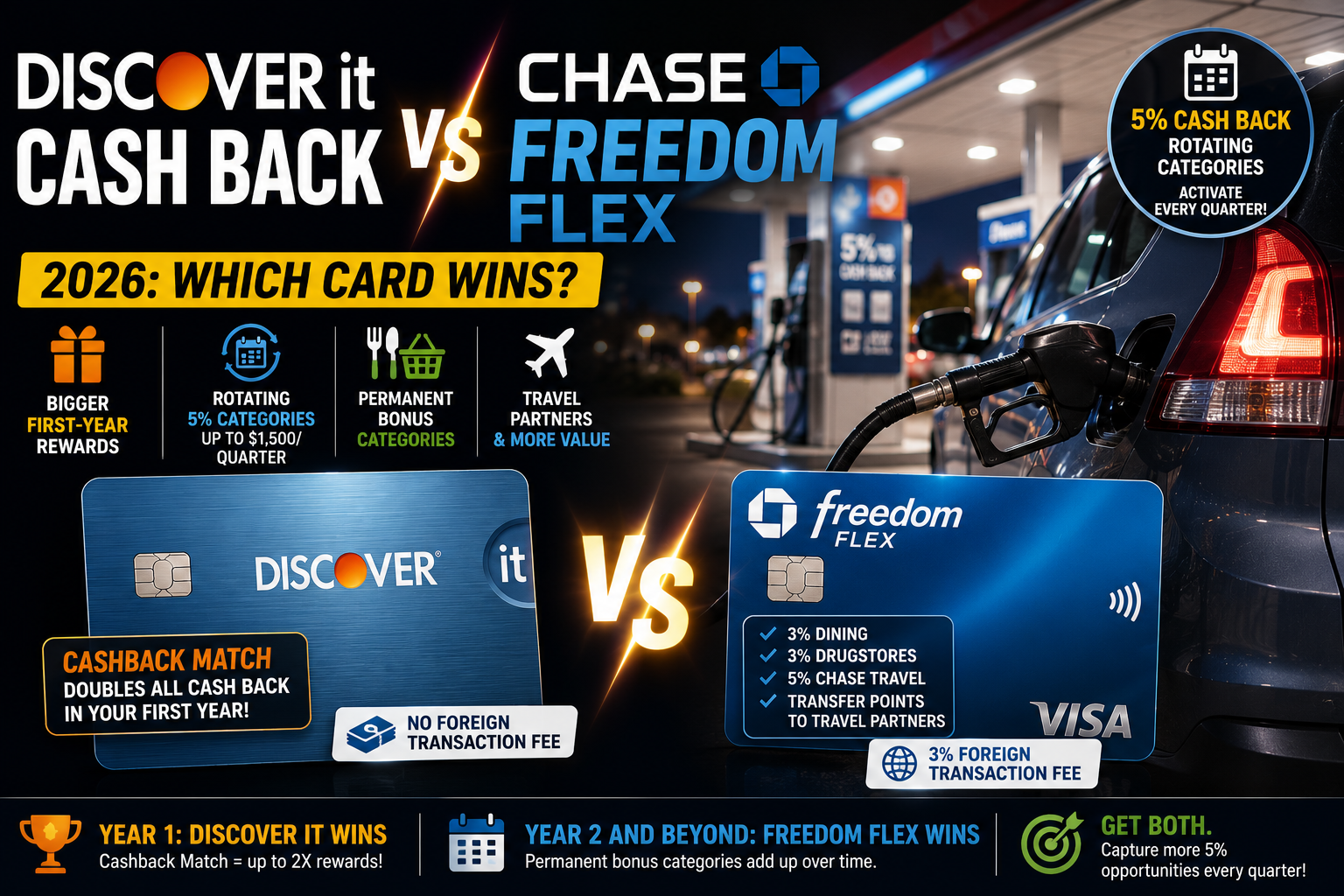

Discover it Cash Back vs Chase Freedom Flex 2026: Which Card Wins?
Both of these no-annual-fee cards share the same core mechanic — 5% cash back on rotating categories you have to activate every quarter. This Discover it Cash Back vs Chase Freedom Flex comparison breaks down where they diverge: the first-year bonus, the permanent categories, and which one wins once that first year ends.
Discover it Cash Back vs Chase Freedom Flex: Quick Comparison
| Feature | Discover it Cash Back | Chase Freedom Flex |
|---|---|---|
| Annual Fee | $0 | $0 |
| Rotating Categories | 5% on up to $1,500/quarter (activation required) | 5% on up to $1,500/quarter (activation required) |
| Permanent Bonus Categories | None | 3% dining & drugstores, 5% Chase Travel |
| Base Rate (everything else) | 1% | 1% |
| First-Year Bonus | Cashback Match: doubles all cash back earned in year one | $200 after $500 spend in 3 months |
| Foreign Transaction Fee | None | 3% |
| Travel Transfer Partners | None | Yes, when paired with a Chase Sapphire card |
In this Discover it Cash Back vs Chase Freedom Flex matchup, the timing matters: Discover tends to win year one, while Freedom Flex tends to win every year after. For official terms, see Discover’s official Cash Back card page.

Why Year One Favors Discover, and Year Two Favors Chase
Discover it wins year one thanks to Cashback Match, which doubles every dollar of cash back you earn in your first 12 months — effectively turning the 5% rotating categories into 10%, and the 1% base rate into 2%. No other no-annual-fee card matches this.
Chase Freedom Flex wins from year two onward. Once Discover’s match expires, both cards earn the same 5% rotating categories, but Freedom Flex adds a permanent 3% on dining and drugstores plus 5% on Chase Travel — categories Discover doesn’t offer at all outside its rotating calendar. Over time, that permanent floor adds up.
Both cards require manually activating the quarterly categories — miss the activation window and you drop to the 1% base rate for that spending instead of 5%.
Pros and Cons
Discover it Cash Back Pros
- Cashback Match doubles all rewards in year one
- No foreign transaction fee
- Simple cash-only redemption, no points to manage
Chase Freedom Flex Pros
- Permanent 3% dining and drugstore categories year-round
- Higher long-term value once year one ends
- Can transfer points to travel partners with a Sapphire card
Who Should Get Each Card
| Your Situation | Best Card |
|---|---|
| You want the biggest possible first-year value | ✅ Discover it Cash Back |
| You plan to keep the card for 3+ years | ✅ Chase Freedom Flex |
| You spend heavily on dining and drugstores | ✅ Chase Freedom Flex |
| You travel internationally often | ✅ Discover it Cash Back |
| You want maximum coverage of rotating categories | ✅ Get both — categories often don’t overlap |
Considering a fixed-category alternative instead? Compare against our Capital One SavorOne vs Chase Freedom Flex review, or see the Best Credit Card for Gas guide if gas is your main spending category.
Frequently Asked Questions
What is Discover’s Cashback Match?
Discover automatically doubles all the cash back you earn during your first 12 months as a cardholder, applied to both the 5% rotating categories and the 1% base rate on everything else.
Do both cards require activating rotating categories?
Yes, both Discover it Cash Back and Chase Freedom Flex require you to manually activate each quarter’s 5% categories, or you’ll only earn the 1% base rate on that spending.
Which card is better after the first year?
Chase Freedom Flex typically pulls ahead from year two onward, thanks to its permanent 3% dining and drugstore categories that Discover doesn’t offer outside its rotating calendar.
Does Discover it charge foreign transaction fees?
No, Discover it Cash Back has no foreign transaction fee, while Chase Freedom Flex charges 3% on international purchases.
Can I hold both cards at once?
Yes, and many cardholders do, since the rotating categories often differ between the two issuers in a given quarter, letting you capture more 5% opportunities overall.
Disclaimer: This article is for informational purposes only and does not constitute financial advice. Card terms, fees, and rewards are subject to change by the issuer; always verify current rates and fees directly with Discover or Chase before applying. We may earn a commission from partner links, which does not affect the objectivity of our reviews.