
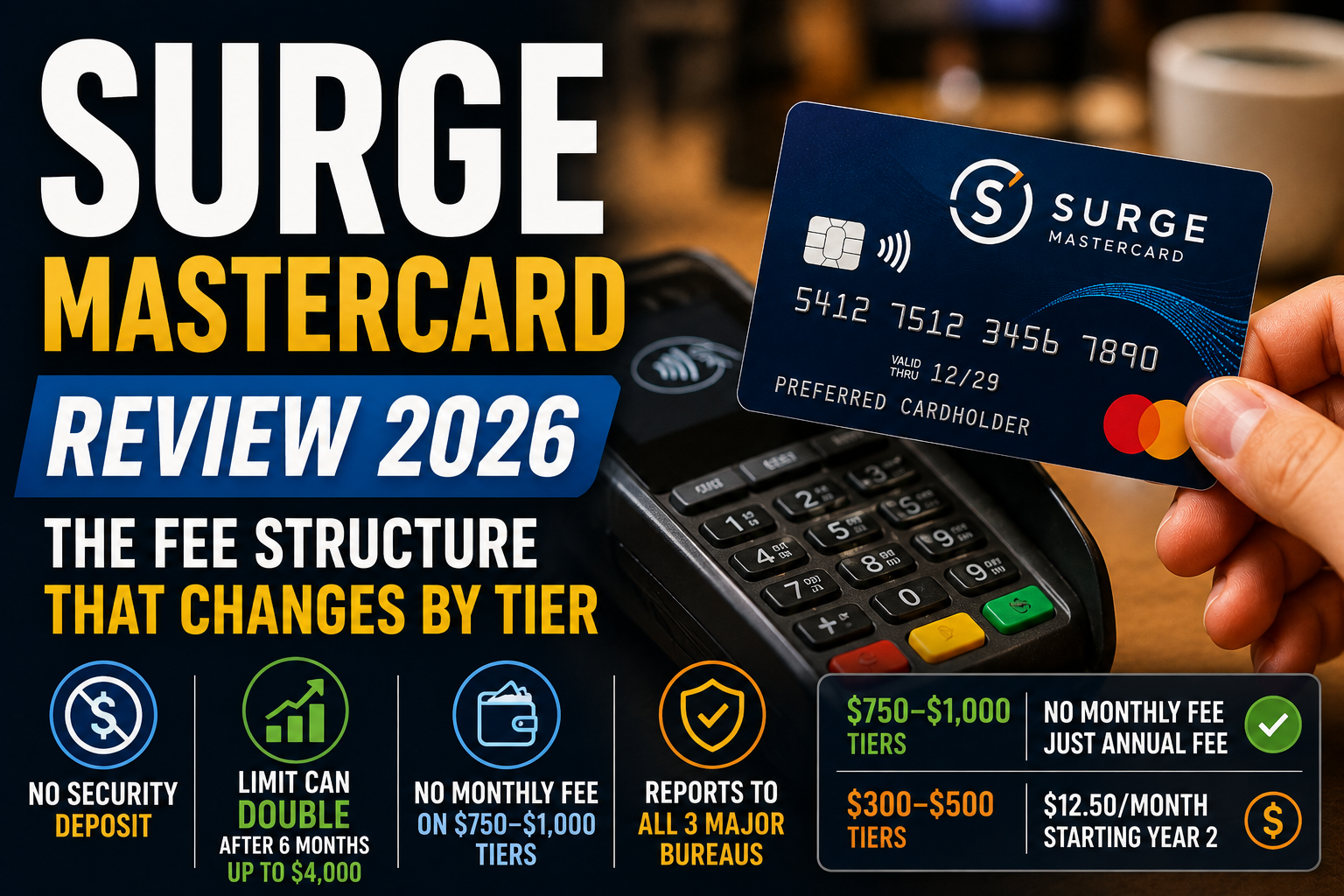

The Surge Mastercard is an unsecured credit card for bad credit that charges $75 to $125 in annual fees plus a fixed 35.90% APR, according to Continental Finance’s official rates and fees disclosure, but its biggest differentiator is that the higher-limit versions skip the monthly fee most competing cards charge every year.
Issued by Celtic Bank and serviced by Continental Finance, the Surge card targets consumers with poor or limited credit who want to avoid a security deposit. Starting credit limits range from $300 to $1,000 depending on the offer, and the account reports monthly to Experian, TransUnion, and Equifax.
Key Details at a Glance
| Feature | Details |
|---|---|
| Issuer | Celtic Bank, serviced by Continental Finance |
| Annual Fee | $75 (at $300 limit) up to $125 (at $1,000 limit) |
| Monthly Fee | $12.50/month on $300–$500 limit tiers; $0 on $750–$1,000 tiers |
| APR | 35.90% fixed on purchases and cash advances |
| Starting Credit Limit | $300, $500, $750, or $1,000 depending on offer |
| Credit Limit Increase | Can double after 6 months of on-time payments, up to $4,000 max |
| Foreign Transaction Fee | 3% of each transaction |
Applicants can check their approval odds through the official Surge card prequalification page, which uses a soft credit pull that doesn’t affect your credit score.

Why the Credit Limit You Get Actually Changes the Math
Most reviews treat Surge as one product, but according to AskMrCreditCard’s fee breakdown, it’s really four different offers depending on the credit limit assigned. Applicants approved at $300 or $500 pay the same $12.50 monthly maintenance fee as cards like Reflex or Fit, pushing total costs toward $275 a year from year two onward.
Applicants approved at $750 or $1,000, however, pay only the annual fee — no monthly charge at all. That makes the higher-limit version of Surge meaningfully cheaper over time than its lower-limit sibling, and notably cheaper than most other cards in this category. If your prequalification offer comes back at $750 or higher, this card is worth serious consideration; if it comes back at $300 or $500, the math looks much closer to its competitors.
Pros and Cons
Pros
|
Cons
|
Who Should Get This Card
The Surge Mastercard fits some financial situations better than others.
| Profile | Fit |
|---|---|
| Prequalifies for the $750 or $1,000 tier | Good fit — no monthly fee makes this a strong option |
| Wants room to grow the credit limit over time | Good fit — highest maximum limit ($4,000) in this category |
| Only prequalifies for the $300 or $500 tier | Compare against the Fit Mastercard first |
| Wants the lowest possible cost regardless of tier | Consider the Destiny Mastercard instead |
If you’re weighing Surge against other Continental Finance cards, our Reflex Mastercard review covers a similar option with a lower maximum credit limit but the same automatic increase structure.
Frequently Asked Questions
Is the Surge Mastercard a legitimate credit card?
Yes. Surge is issued by Celtic Bank, an FDIC-insured Utah industrial bank, and serviced by Continental Finance. It reports account activity to Experian, TransUnion, and Equifax every month.
Does Surge charge a monthly fee?
It depends on your credit limit. Cardholders approved at $300 or $500 pay a $12.50 monthly fee starting in year two. Cardholders approved at $750 or $1,000 pay no monthly fee at all — only the annual fee.
How much does the Surge Mastercard cost per year?
The annual fee ranges from $75 to $125 depending on your credit limit. Total yearly cost can range from $99 (higher tiers, no monthly fee) to roughly $275 (lower tiers, with the monthly fee included).
Can my Surge credit limit increase?
Yes. Cardholders who make their first six monthly minimum payments on time can have their credit limit doubled, with a maximum credit limit of $4,000 over time.
Can I check if I qualify without hurting my credit score?
Yes. Surge’s prequalification process uses a soft credit pull, which doesn’t affect your credit score. A hard inquiry only occurs if you proceed with the full application.
Disclaimer: We are not financial advisors. This review is for informational purposes only and reflects publicly available terms as of 2026. Card terms, fees, and APRs can change — always confirm current details directly with the issuer before applying.