
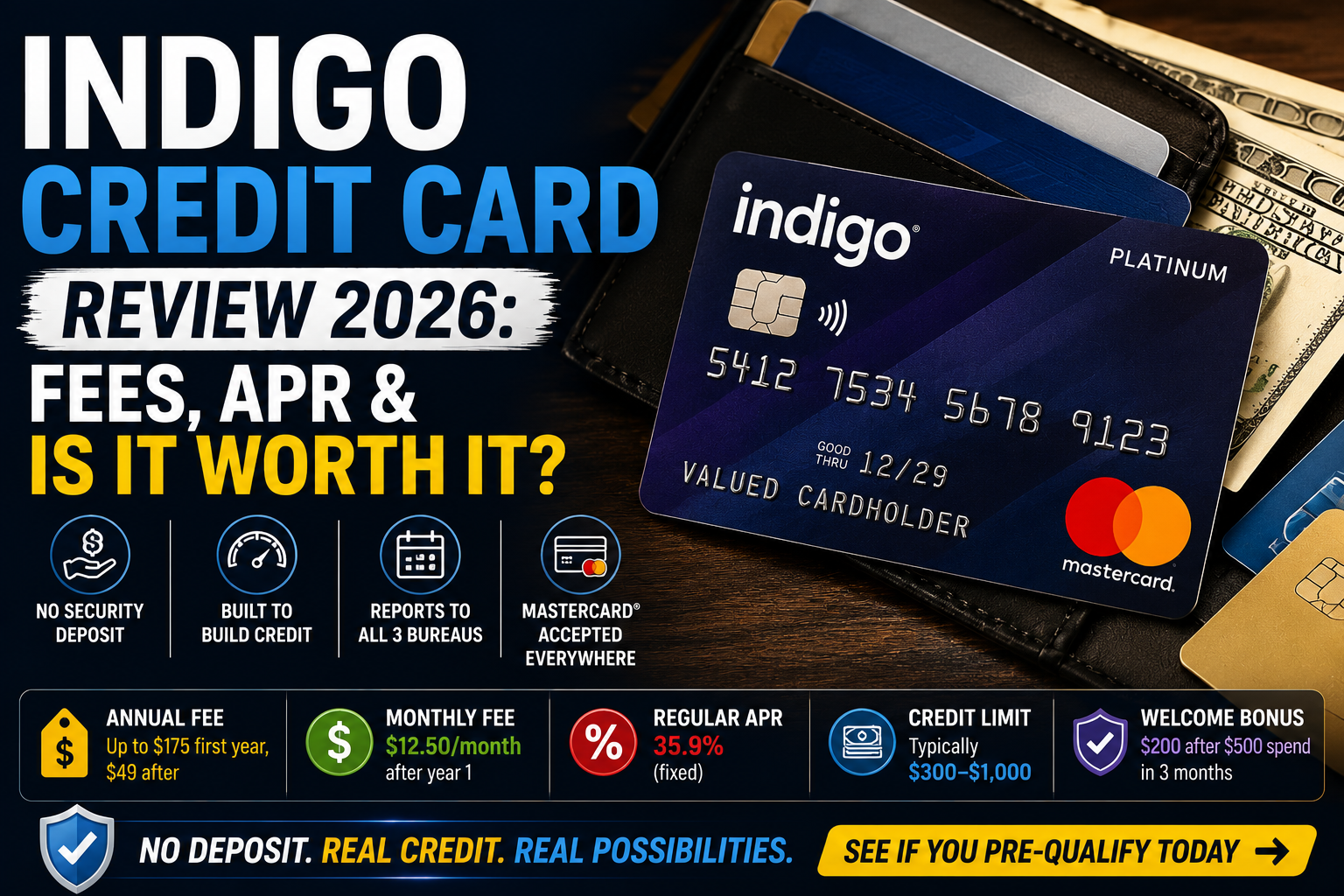
Indigo Credit Card Review 2026: Fees, APR & Is It Worth It?

If you’ve been declined for a mainstream credit card and don’t have savings for a security deposit, you’ve probably come across the Indigo® Mastercard® in your search. In this Indigo credit card review, we break down exactly what this unsecured card costs, who actually qualifies, and whether it’s worth applying for in 2026 — or if a secured card would serve you better.
| Key Details at a Glance | |
|---|---|
| Issuer | Celtic Bank (serviced by Concora Credit) |
| Annual Fee | Up to $175 first year, $49 after (varies by approval terms) |
| Monthly Fee (after Year 1) | $12.50/month on most approval tiers |
| Regular APR | 35.9% (fixed) |
| Starting Credit Limit | Typically $300–$1,000, set during approval |
| Security Deposit | None — fully unsecured |
| Rewards | None |
| Credit Bureau Reporting | Monthly, to all three major bureaus |
You can check official pre-qualification terms directly on Indigo’s website before applying — the process uses a soft credit pull, so checking your eligibility won’t affect your credit score.

Who’s Behind the Indigo Card (and Why That Matters)
The Indigo® Mastercard® is issued by Celtic Bank, a Utah-chartered industrial bank that’s FDIC-insured, and your account is serviced day-to-day by Concora Credit — the same company that used to operate under the name Genesis FS Card Services. Concora has specialized in subprime, credit-building cards for more than two decades. That matters because it confirms this isn’t a scam card despite the aggressive marketing you may have seen: it’s a real Mastercard, accepted anywhere Mastercard is, that genuinely reports your payment history every month.
The Catch: What an Indigo Credit Card Review Won’t Sugarcoat
Here’s the trade-off nobody advertises upfront. Between the annual fee and the recurring monthly charge that kicks in after your first 12 months, you could pay well over $150 in fees during year two alone — on a credit line that might only start at $300. Combined with a 35.9% APR, carrying any balance on this card gets expensive fast. If your goal is simply proving you can manage unsecured credit responsibly for 6–12 months before moving to a better card, the math can work. If you plan to keep this card long-term or carry a balance, it almost never does.
- No security deposit required
- Reports to all 3 credit bureaus monthly
- Soft-pull pre-qualification, no risk to your score
- Realistic option after a recent bankruptcy or denial elsewhere
- High annual fee plus ongoing monthly fee after year 1
- 35.9% APR — very expensive to carry a balance
- Low starting credit limit ($300–$1,000)
- No rewards or intro APR offer of any kind
| Who Should Get This Card | |
|---|---|
| ✅ Good fit | Credit score roughly 300–579, denied for mainstream cards, no savings for a deposit, plans to pay in full monthly |
| ❌ Skip it if | You have $200+ saved for a deposit (a secured card is almost always cheaper) or you’ll carry a balance |
If you’re weighing your deposit-free options, it’s worth comparing this against our Verve Credit Card Review, another no-deposit card aimed at rebuilding credit. And if building credit is part of a bigger financial plan while still in school, our Best Student Credit Cards guide covers lower-fee alternatives worth checking first.
Frequently Asked Questions
Is the Indigo credit card legit?
Yes. It’s issued by Celtic Bank, an FDIC-insured institution, and serviced by Concora Credit, a company with over 20 years in the subprime credit card space. It’s a real Mastercard, not a scam.
Does checking pre-qualification hurt my credit score?
No. Indigo’s pre-qualification process uses a soft credit inquiry, which doesn’t affect your credit score. A hard inquiry only happens if you formally apply.
What credit score do I need for the Indigo Mastercard?
This card is built for applicants with poor to fair credit, generally in the 300–579 range, including people with a recent bankruptcy or no credit card history at all.
Can I avoid the monthly fee?
The monthly fee typically starts after your first 12 months as a cardholder and applies on most approval tiers. It’s built into the card’s cost structure and isn’t something you can opt out of while keeping the account open.
Is there a better alternative to the Indigo card?
If you can set aside $200–$300, a secured credit card usually costs far less over time and often refunds your deposit once you graduate to an unsecured card.
Disclaimer: This review is based on publicly available terms as of July 2026 and independent research. Card terms, fees, and APRs are set by the issuer and may vary by applicant and change over time. Always confirm current terms directly with the issuer before applying. Best Card Guide may earn a commission from partner links, which does not influence our ratings.