
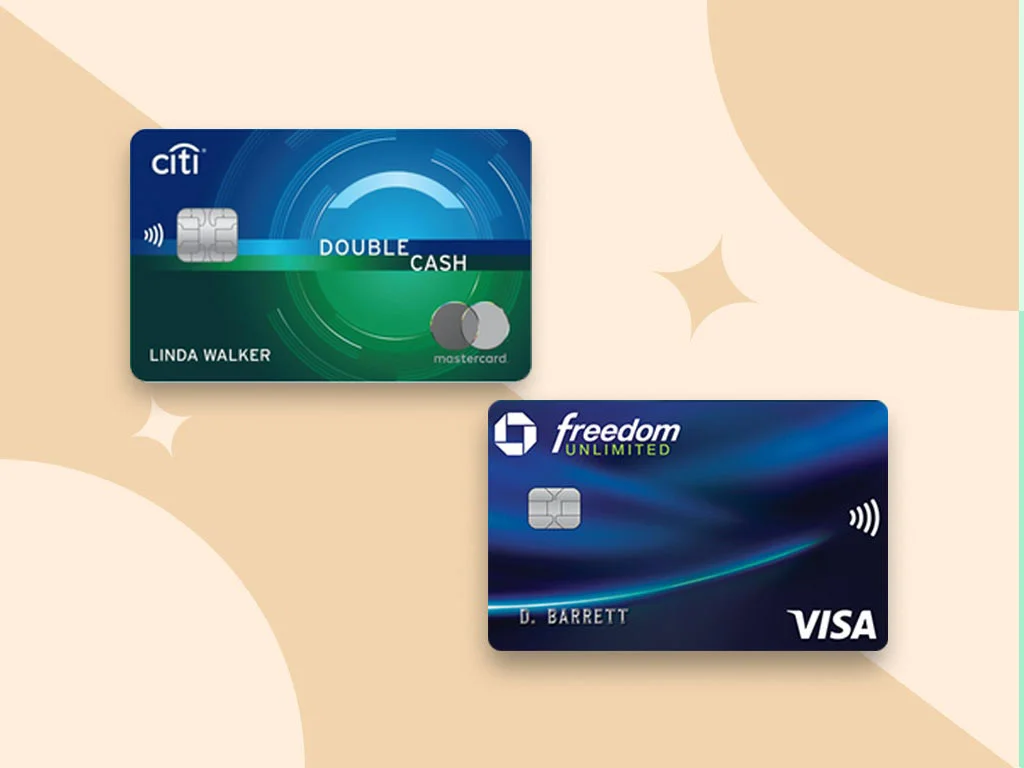
Citi Double Cash vs Chase Freedom Unlimited 2026: Which Card Wins?
If you’re shopping for a no-annual-fee cash back card, these two names come up constantly. This Citi Double Cash vs Chase Freedom Unlimited comparison breaks down the rewards math, welcome bonuses, and APRs so you can decide which one actually fits your spending — or whether it makes sense to carry both.
Citi Double Cash vs Chase Freedom Unlimited: Quick Comparison
| Feature | Citi Double Cash | Chase Freedom Unlimited |
|---|---|---|
| Annual Fee | $0 | $0 |
| Base Earning Rate | 2% (1% on purchase + 1% on payment) | 1.5% on everything |
| Bonus Categories | 5% on hotels, cars & attractions via Citi Travel | 5% Chase Travel, 3% dining & drugstores |
| Welcome Bonus | $200 after $1,500 spend in 6 months | $200 after $500 spend in 3 months |
| Intro APR on Purchases | None | 0% for 15 months |
| Intro APR on Balance Transfers | 0% for 18 months | 0% for 15 months |
| Foreign Transaction Fee | 3% | 3% |
In this Citi Double Cash vs Chase Freedom Unlimited matchup, the core trade-off is simplicity versus category bonuses. For full official terms, see Chase’s official Freedom Unlimited page.

Where Each Card Wins
Citi Double Cash wins on simplicity. A flat 2% on every purchase, with no categories to track, beats Freedom Unlimited’s 1.5% base rate on uncategorized spending. If you spend $5,000 a month outside of bonus categories, that’s $1,200/year with Double Cash versus $900/year with Freedom Unlimited.
Chase Freedom Unlimited wins for category spenders. The 3% on dining and drugstores, plus 5% on Chase Travel bookings, can close or beat that gap if your spending concentrates there. It also has a lower welcome bonus threshold and an intro 0% APR on purchases, which Double Cash doesn’t offer.
Pros and Cons
Citi Double Cash Pros
- Highest flat-rate cash back with no annual fee (2%)
- No categories to track or activate
- Long 18-month intro APR on balance transfers
Chase Freedom Unlimited Pros
- Higher rewards for dining, drugstore, and Chase Travel spenders
- Lower welcome bonus spending requirement
- Intro 0% APR on new purchases, not just transfers
- Can pair with a Sapphire card to unlock airline transfer partners
Who Should Get Each Card
| Your Situation | Best Card |
|---|---|
| You want the simplest possible flat-rate card | ✅ Citi Double Cash |
| You spend heavily on dining or drugstores | ✅ Chase Freedom Unlimited |
| You plan to add a Sapphire card later for travel transfers | ✅ Chase Freedom Unlimited |
| You want the highest welcome bonus for lower spend | ✅ Chase Freedom Unlimited |
| You need 0% intro APR on new purchases | ✅ Chase Freedom Unlimited |
Looking for other flat-rate comparisons? See how the Double Cash stacks up in our Wells Fargo Active Cash vs Citi Double Cash review, or check our Best Credit Card for Groceries guide if grocery spending is your priority.
Frequently Asked Questions
Is Citi Double Cash or Chase Freedom Unlimited better for everyday spending?
For uncategorized everyday spending, Citi Double Cash’s flat 2% beats Freedom Unlimited’s 1.5% base rate — but Freedom Unlimited pulls ahead if your spending concentrates in dining, drugstores, or Chase Travel.
Can I get cash back on both purchase and payment with Citi Double Cash?
Yes, you earn 1% when you make a purchase and another 1% when you pay it off, for an effective 2% as long as you make at least the minimum payment on time.
Do either of these cards charge foreign transaction fees?
Yes, both charge a 3% foreign transaction fee, making neither ideal for frequent international travel.
Which card has the better welcome bonus?
Chase Freedom Unlimited usually wins here, requiring a lower spending threshold ($500 in 3 months) compared to Citi Double Cash’s $1,500 in 6 months for a comparable bonus.
Can I use both cards together?
Yes — many cardholders pair the two, using Freedom Unlimited for its bonus categories and Double Cash’s 2% for everything else, since both carry no annual fee.
Disclaimer: This article is for informational purposes only and does not constitute financial advice. Card terms, fees, and rewards are subject to change by the issuer; always verify current rates and fees directly with Citi or Chase before applying. We may earn a commission from partner links, which does not affect the objectivity of our reviews.