
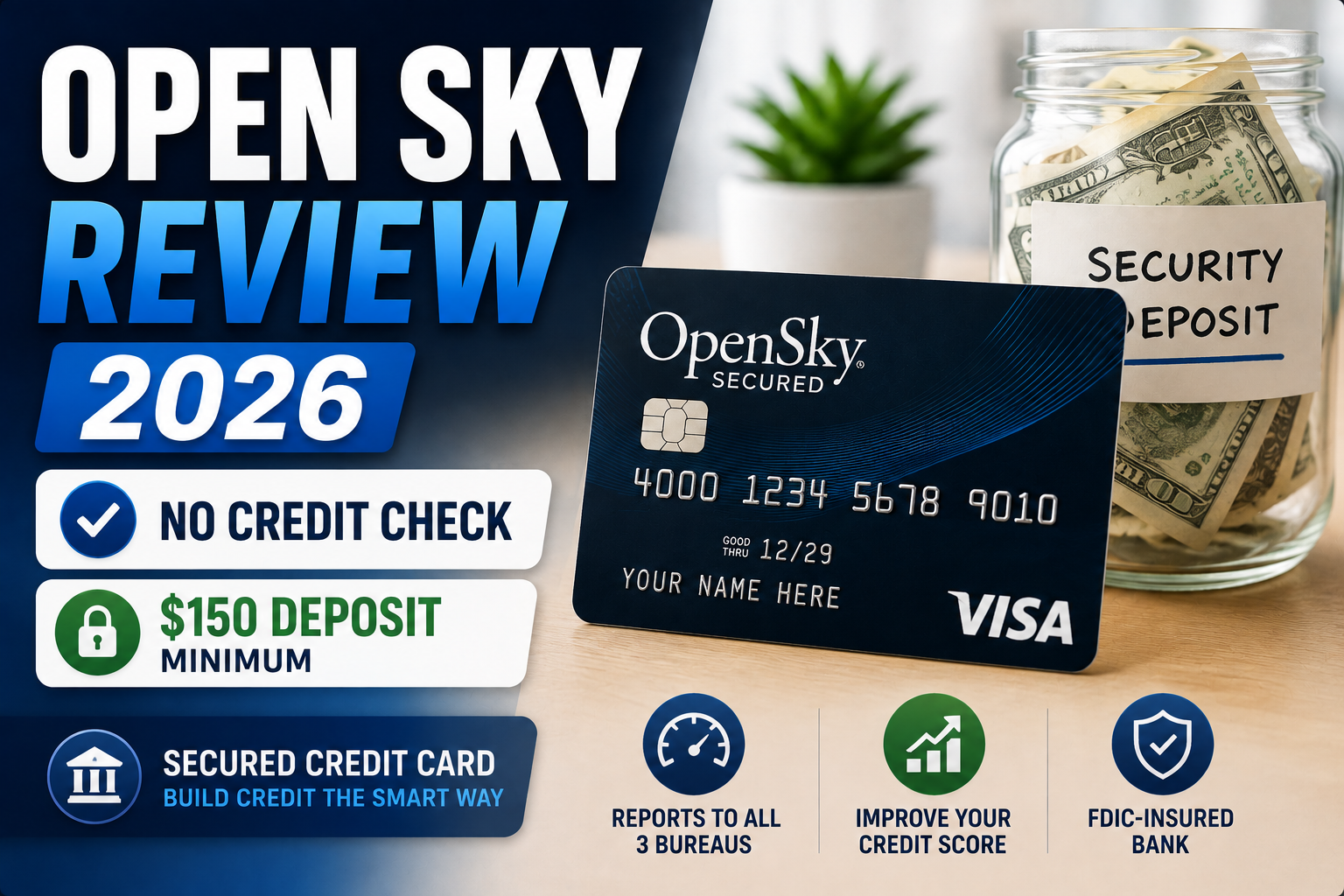

The OpenSky Secured Credit Card skips the credit check most issuers require, approving close to 90% of applicants regardless of credit history, according to Firstcard. Unlike most cards in this category, OpenSky is not one card but a family of three secured options, and picking the wrong one can cost you more than it should.
Issued by Capital Bank, N.A., the OpenSky lineup targets consumers with bad, thin, or no credit who want a straightforward path to build history. All three versions report monthly to Experian, TransUnion, and Equifax, and none require you to open a checking account with the bank.
Key Details at a Glance: All Three OpenSky Cards
| Feature | OpenSky Original | OpenSky Plus | OpenSky Launch |
|---|---|---|---|
| Annual Fee | $35 | $0 | $24 year one, $36 after |
| APR | 23.89% variable | 28.24% variable | 28.74% variable |
| Min. Security Deposit | $200 | $300 | $150 |
| Rewards | Up to 10% cash back at 40,000+ retailers | None | None |
| Credit Check Required | No | No | No |
All three cards charge a 3% foreign transaction fee, a late fee up to $41, and a returned payment fee up to $40. OpenSky lets you spread your deposit payment over 60 days instead of paying it all upfront, and the deposit is fully refundable when you close the account in good standing.

Which OpenSky Card Actually Costs the Least?
This depends entirely on how long you plan to keep the OpenSky Secured Credit Card. According to Firstcard, OpenSky Original ends up cheaper than Plus if you keep the card more than roughly two years, because Plus carries a higher APR with no offsetting rewards. If you can only afford a smaller upfront deposit, Launch’s $150 minimum is the lowest barrier to entry, though its $36 annual fee after year one and higher APR make it the most expensive to hold long-term if you carry a balance.
Because the OpenSky Secured Credit Card requires a security deposit rather than a credit check, the Consumer Financial Protection Bureau recommends confirming in writing that your deposit will be held at an FDIC-insured bank and that it is fully refundable before you send any payment.
NerdWallet notes that Plus requires no annual fee at all, which appeals to anyone who wants to avoid a recurring charge, but its 28.24% APR is meaningfully higher than the Original card’s 23.89%, so carrying a balance on Plus is more costly.
Pros and Cons of the OpenSky Secured Credit Card
Pros
|
Cons
|
Who Should Get the OpenSky Secured Credit Card
| Profile | Fit |
|---|---|
| Was denied elsewhere due to a hard credit check | Good fit: OpenSky runs no credit check on any of its three cards |
| Can only afford a small deposit right now | Good fit: OpenSky Launch starts at $150 |
| Wants a secured card with zero annual fee | Good fit: OpenSky Plus charges $0 per year |
| Wants an unsecured option instead | Poor fit: see our Legacy Credit Card review instead |
Prefer a mail-offer card with a higher starting limit instead of a deposit-based one? Our Legacy Credit Card review and First Access Visa review cover unsecured alternatives. You can also run the numbers on any of these three OpenSky tiers using our Credit Card Fee Calculator before you apply.
Frequently Asked Questions
Does OpenSky check my credit before approving me?
No. None of the three OpenSky secured cards require a credit check, which is one of the main reasons the brand attracts applicants who were denied elsewhere.
Is the OpenSky Secured Credit Card legitimate?
Yes. It is issued by Capital Bank, N.A., an FDIC-insured bank, and reports account activity to Experian, TransUnion, and Equifax every month.
Do I get my deposit back with OpenSky?
Yes, the security deposit is fully refundable when you close your account in good standing, since it acts as collateral rather than a fee.
Which OpenSky card has the lowest APR?
OpenSky Original has the lowest APR of the three at 23.89% variable, compared to 28.24% for Plus and 28.74% for Launch.
Do I need a checking account to get an OpenSky card?
No. OpenSky does not require you to have a bank account to apply for or hold any of its three secured cards.
Disclaimer: We are not financial advisors. This review is for informational purposes only and reflects publicly available terms as of 2026. Card terms, fees, and APRs can change. Always confirm current details directly with the issuer before applying.